


I don’t think I know any woman who wouldn’t want to go slow when making love. In fact, love is that special timeframe where everything slows down – not just during loving sex but the loving exchange between two beings. A mother or father handles their baby with care, holding them quietly. They look at each other in the eyes. This simple look is an anchor for the baby’s brain to connect, to develop its attention and to grow. Love goes slow, spreads, pervades our energy field. Love is subtlety. And love is attention.
Now, before I had my kids, I believed that multitasking meant efficiency. It’s not that I didn’t meditate – I’ve done that since my youth. However, I had this inherited belief that to be productive, you had to multitask and go fast. In my career as a coach and therapist, I’ve come across many women continuously beating themselves up for not doing enough or taking up more than they could chew to prove they were adequate. Those who are slower, who explain things slower, sometimes even their partner or their brother, get on their nerves. To them, their interlocutor is rambling, beating about the bush. Many women have internalised synthesis skills, the ability to summarise, to cut it short and to go fast so as to be.. …so they think.. productive.
Multitasking is in fact just the opposite. When you are focusing on a task and you are interrupted or you interrupt yourself, it will take you 23 minutes to attain the same level of concentration again. An average person touches his phone …… 2.687 times a day !!! 🫣 Reels have hit a home run. Imagine what that means in terms of concentration. JAMA Network Open in 2019 suggested a potential association between higher levels of screen time in preschool-aged children and an increased risk of developing symptoms of attention deficit hyperactivity disorder (ADHD).
On the contrary, slow can mean tuning in to the present, focusing your full attention on the moment. Slow intensifies pleasure and quality. The pleasure of the senses : the sight, the smell, the touch, the taste, the ear …. Imagine just flipping through the works of Monet, Turner or Brueghel… Or listening to Debussy in fast forward. Not to speak of craftsmanship… Slow food restaurants have started to flourish in many cities of the world, and In Madrid itself. Eating slow has other functions as well. It takes the brain 20 minutes to register the stomach is full. Eating slowly can help you control your weight. Moreover paying attention to the taste, texture, smell and above all chewing slowly makes us salivate so we digest better.
As slow reinforces our attention, it allows us to learn. We learn slowly i.e the process of learning takes time. Learning requires the brain to encode information, change its neural wiring and create networks between different regions of the brain. With fast, we carry out automatisms, perform what we already know by accessing the deeply grooved patterns of the brain. Johann Hari, author of Stolen Focus points out that attention is at the core of all the great achievements of Humankind : music, science, sports, being a good parent or having friends and remarks that the number of children with attention deficit has increased 100-fold since he was 7 years old. (We may learn fast under threat, which would however activate stress hormones like cortisol and adrenaline enhancing the brain’s ability to create and retain memories related to the threat. Having said that, a way of learning fast AND safe is through novelty.)
In The Stress Solution, clinical psychologist Arthur Ciaramicoli explains: “We learn to become more empathic when we slow down, become present“. We can quieten our outbursts slowing down. During an argument, intentionally slowing our speech will lower the tension say Newberg and Waldman in “Words can change your brain”. Slowing down makes you stress proof i.e. being at our best under stress “calm, cool and creative in the midst of the storm” as says Eknath Easwaran.
Slow promotes sustainability. Professor Hazel Clark from the Parsons School of Design refers to slow fashion as “the valuing of local resources and distributed economies; transparent production systems with less intermediation between producer and consumer; and sustainable and sensorial products that have a longer usable life and are more highly valued than typical consumables.”
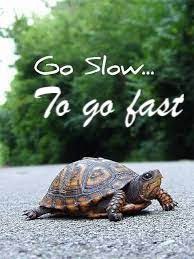
Needless to say that slow in business is a requirement for leaders, those who take risks. Slowing down, creating the time and space will allow them to connect the dots for the best decisions and once taken, change gear and act fast.
When building a management team, pursuing speed and growth at all costs can cause unnecessary stress, dysfunctions and prevent the team from bonding. Leaders may feel the urge to take action and skip the necessary steps for designing key strategies in depth or bypass communication, thus causing misalignment. Not taking the time to confront views and doing without the collective wisdom of the team can overlook opportunities and even hinder innovation. In The fifth discipline, Peter Senge’s ‘slower is faster’ is based on the observation that ‘when speed becomes excessive, the system will seek to compensate by slowing down, perhaps putting the organization’s survival at risk in the process.’
So, wherever you are and whatever you do, for your wellbeing you will find that fast dances with slow. Taking a step back from the rush with intentionality pays off. But remember : slow needs practice !
🤩 You wish to build a healthy, strong and aligned team or leadership team. I’ll be happy to help. Contact me.